5 Hidden Features of the Blackview Mp60 Mini Pc You Must Know About
The Blackview Mp60 Mini Pc has quietly become a popular choice for buyers seeking a compact, versatile computing solution that bridges the gap between small-form-factor desktops and thin clients. While spec sheets list core components such as CPU choices, RAM options, and display outputs, several lesser-known capabilities differentiate real-world experiences. This article highlights five hidden features of the Blackview Mp60 Mini Pc that matter for everyday use and decision-making, gives a balanced review, presents pros and cons, compares it with alternatives, and offers a practical buying guide for prospective purchasers.
Introduction: Why hidden features matter
Mini PCs are often purchased for their space-saving design and energy efficiency, but many buyers care about more than dimensions. Typical considerations include expandability, noise, connectivity, multi-monitor support, remote management, and cross-platform compatibility. The Blackview Mp60 Mini Pc delivers on the obvious metrics, but the value often comes from features that are not immediately obvious at first glance. These hidden capabilities can improve productivity, lifespan, or suitability for specific roles such as home office workstations, media centers, point-of-sale terminals, or light development rigs.
Detailed review and analysis
The Blackview Mp60 Mini Pc positions itself as a balanced, affordable mini PC with a modern set of ports and a compact chassis that supports VESA mounting. Out of the box, the device is appealing to users who want a full desktop experience without a tower: multiple display outputs, a range of USB ports, and both wireless and wired networking options are included on many configurations. However, understanding the unit fully requires looking beneath the surface at firmware behavior, connectivity potential, and maintenance paths.
Key selling points on most models include a small footprint, solid set of I/O, and the ability to run mainstream operating systems. For buyers who prioritize longevity and flexibility, the hidden features described below are where the Mp60 shines or can be made to shine with a bit of configuration.
5 Hidden Features Explained
1. Dual-boot friendly BIOS with quiet fan control
Many buyers notice the Mp60's BIOS offers more than just boot order. The device often includes advanced boot options that make it straightforward to set up dual-boot configurations (for example, Windows and a Linux distribution). The BIOS typically supports legacy and UEFI boot modes, secure boot toggling, and fast boot settings.
Equally important for home and office use is the hidden fan-control profile accessible in firmware. Rather than a fixed “on” fan that ramps to full speed, the Mp60 commonly exposes fan behavior settings that allow the system to run in a quieter profile by default, then increase cooling only under sustained load. This results in better acoustics for conference rooms and living spaces while preserving thermals when needed.
Real-world use: A content creator who alternates between document editing and occasional rendering will appreciate quieter operation during low-load periods without manual fan controls. A small office deploying multiple units for light workloads can lower ambient noise without sacrificing reliability.
2. User-accessible M.2 slot and storage flexibility
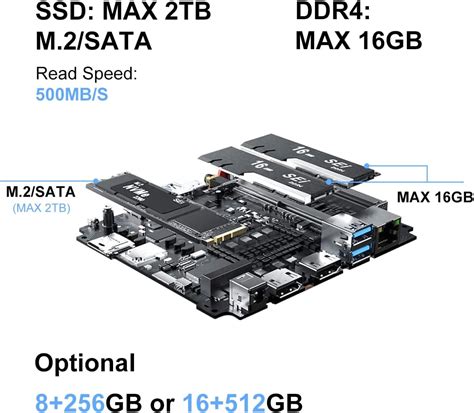
While soldered eMMC or single-drive setups are common in entry-level mini PCs, the Mp60 frequently incorporates an accessible M.2 slot that allows for NVMe SSD upgrades. This is a practical hidden advantage: replacing or upgrading storage is often as simple as opening a single screw, swapping drives, and, if necessary, adjusting boot order in BIOS.
Storage flexibility matters for buyers who plan to use the Mp60 for media libraries, virtual machines, or heavier application loads. An NVMe SSD brings significant responsiveness improvements over SATA or eMMC, and the presence of both an M.2 slot and an additional SATA connector on some variants makes it possible to balance fast OS storage with larger capacity data drives.
Real-world use: A small studio can install a high-capacity NVMe for active projects and use a secondary SATA drive for long-term archives, maintaining performance without buying a high-end workstation.
Looking for the best Laptops & Computers deals on Amazon?
View Offers →3. 2.5GbE or advanced Ethernet with VLAN/Link aggregation support
Networking is a blind spot for some buyers who assume all mini PCs are limited to gigabit Ethernet. The Mp60, in certain configurations, supports 2.5GbE and advanced Ethernet features such as VLAN tagging and link aggregation (LACP), either natively or via driver support. That capability unlocks faster local transfers for NAS-connected workflows and more sophisticated network segmentation in small office environments.
For power users, having a faster-than-gigabit interface on a compact device reduces bottlenecks when streaming high-bitrate media from a home server or quickly moving large datasets between PCs and storage appliances.
Real-world use: A photographer or videographer with a centralized 2.5GbE NAS benefits from reduced import times when tethering or copying media files, improving turnaround time on client projects.
4. Hardware video decoding and efficient multimedia pipelines
Many buyers use mini PCs as media centers or video playback devices. The Mp60 often includes hardware acceleration for modern codecs (H.264, H.265, VP9, and sometimes AV1 depending on the SoC). The presence of hardware decoding is a subtle but impactful feature: playback of 4K streams, HEVC-encoded videos, or transcoding tasks consume far less CPU and produce smoother playback when hardware decode is leveraged.
Additionally, the Mp60 frequently exposes HDMI/DisplayPort features such as HDR passthrough and variable refresh rate handling. When paired with compatible disp…
Real-world use: An at-home media enthusiast who needs a compact Plex client or a living-room PC benefits from low-power, high-quality playback and the ability to drive a 4K TV without stuttering or overheating.
5. BIOS-level power profiles and Wake-on-LAN / remote management options
For deployments where uptime and remote access matter, the Mp60’s BIOS often includes Wake-on-LAN and power recovery options that are easy to enable. Paired with light remote management tools and correct network configuration, the Mp60 can serve as a remote kiosk, edge compute node, or always-on server for tasks that do not require high compute density.
Power profiles at the firmware level allow administrators to set behavior after power loss (remain off, power on, or restore last state), which is critical in commercial or unattended installations.
Real-world use: A small digital signage installation or a home lab will benefit from automatic recovery after outages and the ability to wake or power-cycle systems remotely without physical access.
Shop the latest Laptops & Computers picks on Amazon.
Browse Now →Pros & Cons
- Pros:
- Compact, space-saving design suitable for desktops, media centers, and kiosks
- Hidden upgrade paths such as user-accessible M.2 slot for storage expansion
- Often supports advanced networking (2.5GbE, VLAN, aggregation) for faster local transfers
- Firmware options for quieter operation and remote power behavior
- Hardware video decoding that improves media playback and lowers CPU load
- Cons:
- Some desirable features depend on the chosen configuration or firmware version
- Limited internal space may restrict multi-drive setups compared with small towers
- Upgradeability beyond RAM and storage can be limited; CPU is fixed
- Documentation for hidden BIOS options may be sparse or require community guides
- Thermals under long sustained heavy loads can lead to throttling in a compact chassis
Comparison Table: Blackview Mp60 Mini Pc vs Popular Alternatives
| Model | Typical Ports | Storage Expandability | Network | Best for |
|---|---|---|---|---|
| Blackview Mp60 Mini Pc | Dual HDMI/DP, multiple USB-A, USB-C, audio jack | M.2 NVMe (user-accessible), sometimes SATA | Wi‑Fi + Gigabit or 2.5GbE (varies) | Home office, media center, light workstation |
| Intel NUC (similar class) | HDMI/Thunderbolt, USB-A/C | Often M.2 + 2.5" bay on larger models | Gigabit or 2.5GbE on newer models | Performance-focused compact desktops |
| Beelink / MinisForum Mini PCs | HDMI/DP, multiple USBs, often Type-C | M.2 NVMe and sometimes 2.5" bay | Gigabit / 2.5GbE options | Value-focused mini workstations |
| Raspberry Pi 4 | Micro HDMI, USB, USB-C | microSD primary; M.2 via adapters | Gigabit (over USB2 bridge), Wi‑Fi | DIY projects, very low-cost media centers |
Buying Guide: What to prioritize when choosing a Blackview Mp60 or similar mini PC
1. Intended use and performance needs
Determine whether the unit will be primarily used for office applications, media playback, light content creation, or edge computing. Office and media tasks prioritize quiet operation and hardware video decode, while content creation benefits more from higher-end CPUs and faster NVMe storage.
2. Memory and storage configuration
Check whether the Mp60 configuration allows RAM upgrades and whether an M.2 slot is present. For multi-tab browsing, light photo editing, or running virtual machines, prioritize models that support at least 8–16GB of RAM and an NVMe drive. If the base model relies on eMMC, plan an upgrade path for future-proofing.
3. Ports and external connectivity
Examine the available display outputs, USB types (USB-C with DisplayPort alternate mode is useful), and whether the device provides enough high-speed ports for external drives and peripherals. Buyers who need multiple monitors should confirm support for simultaneous multi-display output at the required resolutions.
4. Networking capabilities
For users who stream high-bitrate content or move large files across a local network, consider models with 2.5GbE or ensure the Wi‑Fi 6 implementation meets expectations. Verify driver availability for advanced Ethernet features if VLANs or link aggregation are intended.
5. Thermals and noise
Compact devices trade space for cooling. If the environment demands low noise (conference rooms, bedrooms), prioritize firmware options that allow quieter fan profiles, or consider passive-cooled variants. Check independent reviews for thermal and acoustics benchmarks rather than relying solely on marketing claims.
6. Software and driver support
Confirm that drivers are available for the chosen operating system, particularly for Wi‑Fi, GPU/hardware decode, and Ethernet adapters. Community support and firmware update channels are a plus—firmware updates can unlock performance improvements and resolve early issues.
7. Expandability and warranty
Look for user-accessible compartments for storage upgrades and check the warranty and support terms. For commercial deployments, consider extended support options or bulk purchase channels that offer predictable replacements and lifecycle management.
Practical tips to unlock the hidden features
- Read the BIOS changelog: Firmware updates sometimes expose or fix hidden options such as fan curves or power behavior. Applying vendor-supplied firmware updates can enable features mentioned in this article.
- Set up hardware-accelerated codecs: In media applications, ensure players or browsers are configured to make use of hardware decoding. On Linux, the right VAAPI or V4L2 drivers matter; on Windows, codecs may be enabled via driver packages.
- Plan storage upgrades: If the device includes an M.2 slot, installing a separate NVMe for the OS and leaving an external drive for bulk storage balances performance and cost.
- Use Wake-on-LAN and BIOS power options: For remote maintenance or scheduled tasks, enable Wake-on-LAN in BIOS and set power recovery behavior to reduce the need for physical intervention.
- Test network features before deployment: If VLANs or link aggregation are needed, bench test with the intended switch and NAS to confirm driver compatibility and throughput.
Conclusion
The Blackview Mp60 Mini Pc is more than a compact PC shell—its hidden features, when understood and configured, can significantly elevate the user experience. From BIOS-level fan management and dual-boot friendliness to storage expandability, advanced networking, hardware video decoding, and practical remote management options, these capabilities make the Mp60 a versatile candidate for a range of real-world applications. Buyers who prioritize longevity, expandability, and quiet operation will find particular value in these lesser-advertised aspects. As with all small-form-factor systems, careful selection of configuration and attention to firmware and driver support determine whether the Mp60 becomes a convenient, long-lasting component of a home or small-office setup.