Difference Between Dwarflabs Dwarf III and DJI Osmo Action 6 Explained
The landscape of specialized digital cameras is undergoing a fascinating transformation as technologies once reserved for professional film sets or high-end observatories shrink into pocketable form factors. For enthusiasts looking to capture the world around them, two names currently represent the cutting edge of distinct niches: the Dwarflabs Dwarf III and the DJI Osmo Action 6. While both are categorized as compact, portable imaging devices, they are designed with fundamentally different philosophies and use cases in mind. One is an intelligent, automated telescope designed to bring the deep cosmos and distant wildlife to your smartphone, while the other is a rugged, stabilized powerhouse built to survive the most extreme physical adventures on Earth.
Choosing between these two devices is not simply a matter of comparing megapixels or battery life. It is about identifying where your curiosity lies. Are you looking up at the Ring Nebula and waiting for a rare bird to land on a distant branch, or are you mountain biking down a narrow trail or diving into a coral reef? This article provides an exhaustive analysis of the Dwarflabs Dwarf III and the DJI Osmo Action 6, exploring their technical architectures, real-world performance, and the specific types of creators they serve.
Detailed Product Analysis: Dwarflabs Dwarf III
The Dwarflabs Dwarf III represents the third generation of "smart telescopes," a category that has revolutionized amateur astronomy and long-range nature photography. Unlike a traditional telescope that requires a tripod, counterweights, and manual star-alignment procedures, the Dwarf III is an all-in-one robotic system. It is roughly the size of a large dictionary and features a dual-lens system that allows it to function as both a wide-angle finder and a telephoto explorer.
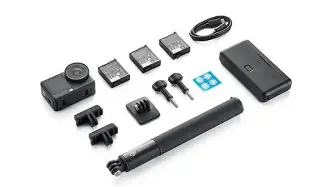
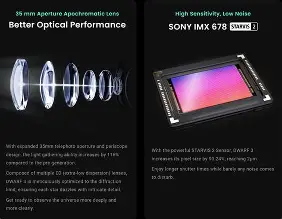
The core appeal of the Dwarf III is its integration of Artificial Intelligence and automated "GoTo" functionality. By connecting the device to a smartphone app, users can select a celestial object—such as the Andromeda Galaxy or the Orion Nebula—and the camera will automatically move its internal prismatic optics to locate, track, and photograph the object. Because the Earth rotates, the Dwarf III uses sophisticated algorithms to compensate for field rotation, allowing for the long-exposure "stacking" required to see the colors and details of deep-space objects that are invisible to the naked eye.
Beyond the stars, the Dwarf III has found a massive following among birdwatchers and wildlife photographers. Its telephoto lens offers significant reach, and the inclusion of AI-powered subject tracking means the camera can follow a perched bird or a moving animal without the user needing to touch the device, which often scares away skittish subjects. It is a "set it and forget it" tool for patient observation.
Pros and Cons of Dwarflabs Dwarf III
- Pro: Fully automated celestial tracking and stacking makes deep-sky astrophotography accessible to beginners without expensive equatorial mounts.
- Pro: Compact and highly portable design allows it to fit into a standard backpack, unlike traditional computerized telescopes.
- Pro: Dual-camera system provides both a wide field of view for context and a telephoto view for detailed captures.
- Pro: AI-based object recognition significantly improves the success rate of tracking fast-moving wildlife or specific constellations.
- Con: Limited versatility for general photography; the fixed telephoto nature makes it unsuitable for everyday family photos or selfies.
- Con: Dependent on a smartphone interface for almost all operations, which can be a hurdle in areas with extreme cold where phone batteries drain quickly.
- Con: Physical durability is not rated for extreme weather; it is a precision instrument, not a ruggedized action tool.
Detailed Product Analysis: DJI Osmo Action 6
The DJI Osmo Action 6 is the latest evolution in the dominant "action camera" sector. While the Dwarf III looks outward toward the horizon and the stars, the Osmo Action 6 is centered on the user and their immediate environment. It is built to be an indestructible witness to human movement. Featuring a large imaging sensor and a wide-angle lens, it excels at capturing high-dynamic-range (HDR) video in lighting conditions that would traditionally crush the detail in shadows or blow out the highlights of a bright sky.
The defining characteristic of the Osmo Action 6 is its stabilization technology. DJI’s RockSteady and HorizonSteady systems use electronic image stabilization (EIS) to smooth out the most violent vibrations. Whether the camera is mounted to a surfboard, a helmet, or a vibrating car engine, the resulting footage looks as though it was shot on a professional gimbal. Furthermore, the Action 6 is designed for speed; its magnetic mounting system allows users to swap the camera between different accessories in seconds, ensuring that no moment of the action is missed.
Thermal management is another area where the Action 6 shines. Action cameras are often prone to overheating when recording at high resolutions like 4K at 120 frames per second. DJI has optimized the internal structure and software of the Action 6 to allow for extended recording times even in warm climates. It is also natively waterproof to significant depths without an external housing, making it the primary choice for divers and snorkelers.
Discover deals on Cameras & Photography — updated daily.
View Offers →Pros and Cons of DJI Osmo Action 6
- Pro: Industry-leading stabilization ensures professional-grade video even during high-intensity physical activities.
- Pro: Rugged, waterproof, and freeze-resistant construction makes it reliable in environments where other cameras would fail.
- Pro: Dual touchscreens (front and back) make framing shots easy for both traditional filming and vlogging/selfies.
- Pro: High-frame-rate capabilities allow for stunning slow-motion footage in 4K resolution.
- Con: Wide-angle lens creates a "fisheye" distortion that is not ideal for flat, representational photography or distant subjects.
- Con: Digital zoom is limited and loses significant quality, making it useless for astronomy or long-range wildlife.
- Con: Battery life is optimized for short bursts of high-action recording, rather than the multi-hour monitoring required for star tracking.
Key Differences: Macro vs. Micro Perspectives
The fundamental difference between these two devices lies in the focal length and the intended distance of the subject. The DJI Osmo Action 6 uses an ultra-wide lens, designed to capture as much of the environment as possible. This is essential for action sports because it provides a sense of speed and ensures that even if the camera moves slightly, the subject remains in the frame. It is built for subjects between 1 and 20 feet away.
The Dwarflabs Dwarf III, conversely, is built for subjects that are either miles away or light-years away. It is essentially a periscope for the digital age. Its telephoto optics are designed to magnify distant details. If you tried to use the Dwarf III to film a standard family birthday party, you would only be able to see a single eye of a person across the table. If you tried to use the Osmo Action 6 to photograph the craters on the moon, the moon would appear as a tiny, overexposed white dot in a sea of black sky.
Technical Comparison Table
| Feature | Dwarflabs Dwarf III | DJI Osmo Action 6 |
|---|---|---|
| Primary Use | Astrophotography & Wildlife | Action Sports & Vlogging |
| Lens Type | Dual Lens (Wide + Telephoto) | Single Ultra-Wide Angle | Stabilization | Robotic 2-Axis Tracking | RockSteady 4.0 / HorizonSteady (EIS) |
| Durability | Weather-resistant (Light rain) | Waterproof (up to 20m), Shockproof |
| Storage | Internal + microSD Support | microSD Support |
| Weight | Approximately 1.2kg | Approximately 145g |
| Special Features | AI Star Tracking, Auto-Stacking | 4K/120fps, Magnetic Mounting |
Real-World Use Cases
To better understand which camera fits your lifestyle, it is helpful to look at how they perform in the field. Imagine a weekend trip to a national park. A photographer carrying the DJI Osmo Action 6 would likely have it clipped to their backpack strap or mounted on a selfie stick. They would use it to record the hike itself, capturing the wide vistas of the trail, the laughter of their friends, and perhaps a first-person perspective of crossing a rushing stream. The camera is part of the movement.
A photographer carrying the Dwarflabs Dwarf III on that same trip would behave differently. They would wait for the sun to set or for the group…
The DJI user values immersion and narrative. The Dwarflabs user values discovery and detail. One camera captures what it feels like to be there; the other captures what is usually hidden from view.
Buying Guide: Which One Should You Choose?
Because these devices serve such different purposes, the buying decision should be based on your primary hobby. Here are the specific criteria to consider before making your purchase:
Choose the Dwarflabs Dwarf III if:
You have a growing interest in astronomy but are intimidated by the complexity of traditional telescopes. The Dwarf III removes the barrier of entry for astrophotography. It is also the superior choice for "stationary" nature enthusiasts. If you are a bird watcher who wants to keep a digital life list, or if you enjoy sitting on your balcony and watching ships in a harbor or animals in a distant valley, the Dwarf III is your best companion. It is a tool for the curious mind that enjoys slow-paced, methodical observation.
Choose the DJI Osmo Action 6 if:
You lead an active lifestyle or want to document your travels in a high-energy way. The Osmo Action 6 is for the creator who needs a camera that can be dropped, submerged, or frozen without skipping a beat. It is the better choice for vloggers because of its front-facing screen and excellent internal microphones. If your goal is to produce content for social media—such as Instagram Reels, TikToks, or YouTube travel videos—the wide-angle look and incredible stabilization of the DJI are the industry standards for a reason.
Find top-rated Cameras & Photography products at great prices.
Browse Now →Considerations for Both:
It is worth noting that neither of these cameras is intended to replace a primary smartphone or a dedicated mirrorless camera for "standard" photography. The Dwarf III lacks the high-speed autofocus and ergonomics for handheld street photography, while the Osmo Action 6 produces a specialized wide-angle look that can get repetitive if used for every single shot. Both are specialized additions to a photography kit rather than all-in-one solutions.
Technical Evolution and Ecosystems
When you buy a Dwarflabs product, you are entering an ecosystem centered on software-assisted optics. Dwarflabs frequently updates their firmware to include new celestial objects in their database and to refine their AI tracking algorithms. The value of the Dwarf III is likely to increase over its lifespan as the software becomes more adept at identifying and processing images. It is a product of the "computational photography" era, where the processor is just as important as the glass lens.
DJI, on the other hand, provides one of the most robust accessory ecosystems in the world. Buying an Osmo Action 6 means you have access to thousands of mounts, filters, external microphones, and battery cases. Their "Mimo" app is highly polished, offering professional-level editing tools and quick-transfer capabilities that allow you to go from filming to posting in minutes. DJI’s focus is on the workflow—making it as frictionless as possible to capture and share your life.
Conclusion
Comparing the Dwarflabs Dwarf III and the DJI Osmo Action 6 reveals the incredible diversity of the modern camera market. These are both high-quality, high-performance machines, but they occupy opposite ends of the photographic spectrum. The Dwarf III is a window to the distant and the faint, utilizing robotic precision and AI to conquer the challenges of long-range imaging. It is an instrument of patience and wonder, perfect for those who want to explore the secrets of the sky and the wilderness from a distance.
The DJI Osmo Action 6 is an instrument of presence and resilience. It is designed to be in the middle of the chaos, smoothing out the rough edges of an adventurous life and ensuring that the most fleeting moments are captured in crystal-clear high definition. It thrives where other cameras fail, making it the essential tool for the athlete, the traveler, and the storyteller.
Ultimately, the "better" camera is whichever one aligns with your passion. If your eyes are usually turned toward the stars or the distant horizon, the Dwarf III will provide a level of capability that was impossible at this size and price point just a few years ago. If your eyes are directed at the path ahead—the water, the trail, or the mountain—the Osmo Action 6 is the definitive rugged companion that will never let you down.