Difference Between Tp Link Re655Be and Netgear Eax17 Explained
Category: Laptops
Shoppers looking to fix dead zones, strengthen home office connectivity, or improve streaming performance often end up comparing two very different kinds of Wi-Fi extenders: the Tp Link Re655Be and the Netgear Eax17. At first glance, both products seem to solve the same problem. They are designed to expand wireless coverage and help devices stay connected farther away from the main router. In practice, though, they target different buyers, different budgets, and different generations of home networks.
The biggest difference is simple: the Tp Link Re655Be is a much newer, more advanced Wi-Fi 7 range extender, while the Netgear Eax17 is a more mainstream Wi-Fi 6 extender. That single distinction affects nearly everything else, including speed potential, tri-band versus dual-band design, future-readiness, wired connectivity, and the kind of household each model serves best.
For buyers trying to decide between them, the right choice usually comes down to a few practical questions. Is the network already using a modern router with high-speed internet? Are there dozens of devices competing for bandwidth? Is the extender intended for basic browsing in a spare room, or for gaming, 4K streaming, and remote work in a larger home? Those are the real-world concerns that matter more than marketing labels.
This article explains the difference between Tp Link Re655Be and Netgear Eax17 in detail, including specifications, day-to-day performance expectations, strengths, weaknesses, and which type of user each product fits best.
Quick Overview: How These Two Extenders Differ
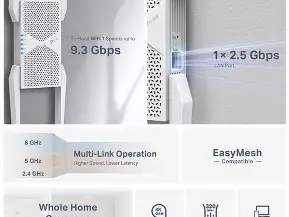
The Tp Link Re655Be is built for households moving into the latest generation of networking. It supports Wi-Fi 7, uses a tri-band design, and includes a 2.5 Gigabit Ethernet port. It is meant for demanding environments where users want stronger performance headroom, better handling of congestion, and improved long-term value if newer devices are being added over time.
The Netgear Eax17, by contrast, is a more accessible extender for buyers who want solid performance without paying for bleeding-edge features. It supports Wi-Fi 6, uses a dual-band setup, and includes a Gigabit Ethernet port. That makes it a practical fit for average homes where the goal is simply to improve coverage for laptops, phones, smart TVs, and smart home devices without overcomplicating the setup.
Comparison Table: Tp Link Re655Be vs Netgear Eax17
| Feature | Tp Link Re655Be | Netgear Eax17 |
|---|---|---|
| Wi-Fi Standard | Wi-Fi 7 | Wi-Fi 6 |
| Band Design | Tri-band | Dual-band |
| Theoretical Speed Class | Up to BE11000 class | Up to AX3000 class |
| 6 GHz Support | Yes | No |
| 5 GHz Support | Yes | Yes |
| 2.4 GHz Support | Yes | Yes |
| Ethernet Port | 1 x 2.5GbE | 1 x 1GbE |
| Best For | Large homes, heavy traffic, future-ready setups | Mainstream homes, everyday coverage extension |
| Likely Buyer | Performance-focused or long-term upgrader | Value-focused household user |
Tp Link Re655Be Review and Analysis
What It Is
The Tp Link Re655Be is a premium range extender designed for users who want more than basic signal boosting. Its headline feature is Wi-Fi 7 support, which places it in a much more advanced category than most traditional extenders. It also adds a tri-band architecture, meaning it can work across 2.4 GHz, 5 GHz, and 6 GHz bands instead of being limited to just two.
That matters because extenders often struggle when they have to receive and retransmit traffic over already crowded airwaves. A more capable tri-band design gives the Tp Link unit more flexibility in how it handles traffic, especially in homes with many connected devices.
Why Buyers Consider It
People usually look at the Re655Be when they have one or more of the following needs:
- They already own, or plan to buy, a Wi-Fi 7 router.
- They have gigabit-class or faster internet service.
- They want stronger wireless performance in upstairs rooms, detached offices, or larger floor plans.
- They rely on bandwidth-heavy tasks such as cloud backups, 4K or 8K streaming, game downloads, or remote work with frequent video meetings.
- They want a more future-ready extender so they do not need to upgrade again soon.
Real-World Strengths
In practical use, the biggest advantage of the Re655Be is not just raw speed on a spec sheet. It is capacity and flexibility. In a household where laptops, tablets, game consoles, TVs, phones, and smart home devices are all active, a more advanced extender can help maintain steadier performance in the parts of the home that usually feel weak or inconsistent.
For example, someone working from a bedroom office at the far end of the house may care less about maximum theoretical throughput and more about stable video calls, quick file uploads, and fewer dropouts. A family using a media room where the main router signal is weak may care more about smooth high-resolution streaming than about benchmark numbers. The Re655Be is built with those heavier, more demanding scenarios in mind.
Discover deals on Laptops & Computers — updated daily.
Shop Amazon →Its 2.5GbE port is another notable advantage. Buyers who connect a desktop PC, a gaming console, or even a switch near the extender can potentially benefit from faster wired backhaul or stronger wired local connectivity than a typical Gigabit-only model allows.
Potential Drawbacks
The main issue is that not every home can take full advantage of it. If the router is older, the broadband plan is modest, and the household mostly uses devices for web browsing and occasional streaming, the Re655Be may be more extender than necessary. Buyers should also expect it to sit at a higher price point than basic Wi-Fi 6 extenders, which can make the value equation less appealing for casual users.
Pros and Cons of Tp Link Re655Be
- Pros
- Supports newer Wi-Fi 7 networks
- Tri-band design adds flexibility and helps with congestion
- Includes 6 GHz support for newer compatible devices
- 2.5GbE port is better suited for faster wired connections
- Well suited to larger homes and heavier network usage
- More future-proof than mainstream Wi-Fi 6 extenders
- Cons
- Likely more expensive than entry and midrange alternatives
- Benefits are reduced if paired with an older router
- Can be overkill for light users with modest internet plans
- Wi-Fi 7 advantages depend on the rest of the network ecosystem
Netgear Eax17 Review and Analysis
What It Is
The Netgear Eax17 is positioned as a practical Wi-Fi 6 range extender for households that need better coverage but do not necessarily need top-tier networking features. It focuses on expanding usable signal in common home environments without aiming for the highest-end enthusiast market.
Its dual-band design covers 2.4 GHz and 5 GHz, which is still more than enough for many homes. Most connected devices today continue to rely on those two bands, especially laptops, tablets, smart speakers, security devices, and streaming hardware already in use.
Why Buyers Consider It
The Eax17 tends to appeal to shoppers who want a simpler upgrade path. They may not be rebuilding the whole network around the l…Typical Eax17 buyers often care about:
- Reasonable pricing compared with premium extenders
- Straightforward setup through an app or WPS
- Compatibility with a wide range of routers
- Enough performance for modern phones, laptops, and TVs
- Reliable coverage for normal home use rather than cutting-edge networking
Real-World Strengths
For many households, Wi-Fi 6 still represents a very sensible sweet spot. It can support multiple active devices better than older Wi-Fi 5 hardware, and it usually provides enough bandwidth for remote work, web browsing, streaming, casual gaming, and general family use.
In real homes, that means the Eax17 can be a solid answer for situations such as:

- A student needing stable laptop connectivity in an upstairs room
- A family wanting fewer buffering issues on a smart TV in the den
- A remote worker who needs more dependable video calls away from the main router
- A mid-size home where dead zones are annoying but not severe enough to justify a premium Wi-Fi 7 solution
The Gigabit Ethernet port is also useful for devices like consoles, desktops, or streaming boxes that benefit from a wired connection at the endpoint, even if the extender itself is connected wirelessly back to the router.
Potential Drawbacks
The Eax17’s limitations are tied to its class. It lacks 6 GHz support, does not offer the extra headroom of a tri-band Wi-Fi 7 design, and tops out with a standard Gigabit Ethernet port. That does not make it a weak product; it simply means buyers should not expect it to perform like a premium next-generation extender in high-density or high-bandwidth environments.
Homes with very fast internet service, advanced routers, or many simultaneous heavy users may eventually find it less future-ready than they want.
Discover deals on Laptops & Computers — updated daily.
Shop Amazon →Pros and Cons of Netgear Eax17
- Pros
- Good fit for mainstream home networking needs
- Wi-Fi 6 is still modern enough for many laptops and mobile devices
- Simpler and likely more affordable than premium Wi-Fi 7 extenders
- Suitable for streaming, browsing, remote work, and routine household use
- Gigabit Ethernet port adds flexibility for nearby wired devices
- Cons
- No 6 GHz support
- Dual-band design offers less flexibility than tri-band options
- Not ideal for buyers seeking maximum future-proofing
- May feel limited in very large or highly congested homes
- Less appealing for multi-gig internet setups
The Main Differences Explained in Plain Terms
1. Wi-Fi 7 vs Wi-Fi 6
This is the clearest distinction. The Re655Be is designed for the newest generation of home wireless networking, while the Eax17 is built for the current mainstream generation. Buyers with newer routers and newer client devices stand to gain more from the Tp Link model. Buyers with ordinary home setups may not feel much practical benefit from jumping all the way to Wi-Fi 7 yet.
2. Tri-Band vs Dual-Band
A tri-band extender can manage traffic more effectively in busy environments because it has more wireless resources to work with. That can matter in larger households with many active devices. A dual-band extender is usually enough for lighter or moderate usage, but it has less room to maneuver under heavy network load.
3. Future-Readiness
The Re655Be is the more future-looking choice. Someone buying networking gear with the intention of keeping it for years may prefer the extra overhead. The Eax17 is more about solving today’s coverage issues without paying a premium for technology the household may not use immediately.
4. Wired Connectivity
The 2.5GbE port on the Tp Link unit gives it a real advantage for faster local connections and higher-end setups. The Netgear model’s Gigabit port is still useful, but it is aimed at more ordinary home networking scenarios.
5. Value vs Performance
The Netgear Eax17 is easier to recommend for buyers who want solid performance-per-dollar. The Tp Link Re655Be is easier to recommend for buyers who prioritize maximum capability, newer standards, and longer-term network planning.
Buying Guide: Which One Should Buyers Choose?
Choose the Tp Link Re655Be if:
- The home already uses a Wi-Fi 7 router or a high-end recent router
- The internet plan is gigabit or faster
- There are many connected devices and frequent simultaneous usage
- The extender will serve a demanding area such as a gaming room, large office, or media-heavy section of the house
- The buyer wants stronger long-term value and fewer reasons to upgrade again soon
Choose the Netgear Eax17 if:
- The goal is to solve dead zones without overspending
- The household uses a Wi-Fi 6 or mixed Wi-Fi 5/Wi-Fi 6 environment
- The main needs are browsing, streaming, video calls, homework, and everyday laptop use
- The internet plan is moderate rather than multi-gig
- The buyer values simple setup and practical coverage improvement over premium specifications
Questions Buyers Should Ask Before Deciding
Before picking either model, it helps to think through the full network picture rather than focusing only on extender branding.
- What router is already in use? A premium extender paired with an outdated router will not deliver its full value.
- How fast is the internet plan? Many homes do not need premium multi-band performance if broadband speeds are modest.
- How many devices are active at once? Larger families and smart homes benefit more from higher-capacity gear.
- What is the weak-signal area used for? A guest room used for email has different needs than a remote office or gaming room.
- Is future-proofing worth paying extra for? Some buyers prefer to buy once and keep the hardware longer, while others just want the most cost-effective solution for current needs.
Final Verdict
The difference between Tp Link Re655Be and Netgear Eax17 comes down to network ambition. The Tp Link Re655Be is the better pick for advanced users, larger homes, higher-speed internet plans, and buyers who want next-generation Wi-Fi features with more room to grow. It is the more powerful and more future-ready extender.
The Netgear Eax17, however, is likely the smarter choice for many ordinary households. It addresses the most common problem buyers face—poor coverage in part of the home—without demanding that they invest in premium-class hardware. For everyday laptop use, streaming, video calls, and standard family networking, it remains a practical and balanced option.
In short, buyers who want the best technology and stronger long-term headroom should lean toward the Tp Link Re655Be, while buyers who want dependable Wi-Fi extension at a more mainstream level should look closely at the Netgear Eax17. The right pick is less about which extender is universally better and more about which one matches the network that is actually in the home.